
The Dobermann came about in rather a unique manner, through the efforts principally of one man whose interest and involvement were so great that upon his death the breed of dog he had created was named for him by those carrying on his work. This man was Herr Karl Friedrich Louis Dobermann, who was born on February 2, 1823 and lived in Apolda, located in the state of Thuringia Germany.
Many years were spent perfecting Dobermanns dream - that of creating a dog somewhat similar to a giant terrier (Pinscher), although actually medium size as compared to huge. These dogs were to be fearless, intelligent, and quick to learn. Great strength was important. Herr Dobermann had a clear and definite mental picture of his dog, and obviously the "breeder's sense" of how to go about making this dog a reality.
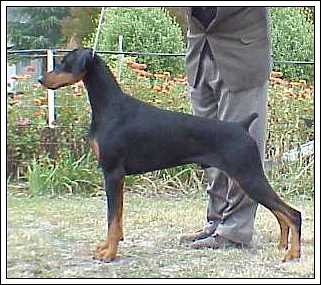
The general conformation, physical make up and appearance of a Dobermann should be a dog or bitch that at first glance be of medium size with a body that is square, the height to shoulder being equal to its body length. The ideal height being Males 26-27 inches and Bitches 24-25 1/2 inches at the wither.
The written standard under the auspices of the English Kennel Club is specific in defining general conformation and over all appearance and attributes that make up the ideal Dobermann. It is true to respect that the Dobermann is a short backed galloper and is a working dog bred to be a constant loyal companion and guard of his master and family along with their possessions.
It requires breed fundamentals, which is termed 'type'. His size and physical make up is 'medium' in every characteristic and appearance. In no way is he overdone? He should be powerful, muscular, compactly built, adequate bone and substance to go with it. He should not be heavy or cumbersome allowing for lighting fast reactions and agility tat sets the Dobermann apart from other breeds and is the very essence of a Dobermann. Only a medium dog with these many important can create a dog with a combination of endurance and speed.
The Dobermann comes in four colours. Black and rust red markings, (commonly called a black and tan,) Brown and rust red, (commonly called red and rust,) Blue and rust red markings, and a Fawn and rust red markings. The latter one is not an allowable colour to be shown in New Zealand. Both the blue and fawn are harder to come by in New Zealand.
The coat is short and dense and hard that seems to cling to the skin and a good coat will return almost immediately to the position with scarcely a hair out of place.
The Dobermann has a docked tail normally at two joints but never should be less than one, neither too long nor too short. The Dobermann should have a head long and tight fitting resembling a blunt wedge viewing from both front and profile views and in balance and proportion to the other parts of the dog. A dark eye is preferred in all colours of the breed. The eye appears to be alert but kindly.
Attributes
The Dobermann should be substantial but elegant; he is to be energetic, watchful and determined, alert, fearless, loyal and obedient.
The Dobermann is a dog who must have grace and dignity.
Origin and Ancestry
The breed history starts in 1891 after the Franco - Prussian war of 1880. Growth of population created the disappearance of wolfs fences and railways were being built. In Apolda, Theuring Germany, from 1834-1894 lived a tax collector and among other things a dog fancier. He needed a guard watch dog to accompany him on his rounds. His name was Louis Dobermann. To get the particular dog he wanted he bred and crossbred local dogs towards this line. In another small town near Apolda lived Otto Goellar, who is credited with the real establishment of the breed. The name had already been established prior to Goellar's on-going breeding attempts.
Some of the many breeds suggested that were possibly used in the strong establishment of the bred were; Rotttweiler; the old German Pinscher of terrier type, the old German Shepherd, of black and tan colour, some of the sporting dogs possibly the English and Gordon Setter, the Blue Great Dane, The Weimaraner, the Manchester Terrier and a black English Greyhound. Of all this mixture came the germ cell of our breed today. In 1910 the modern Dobermann appeared.
The earliest entries in a German studbook were in 1893 and 1894; the German having made great progress in a short span of roughly twenty years. The Dobermann being used in the 1st world was as a messenger carrier and a guard dog. The Dobermann since then has been used as a guard and security dog, seeing eye dog, police dog, army dog, search and rescue dog, airport dog, utility dog, and the majority as a family pet.